New
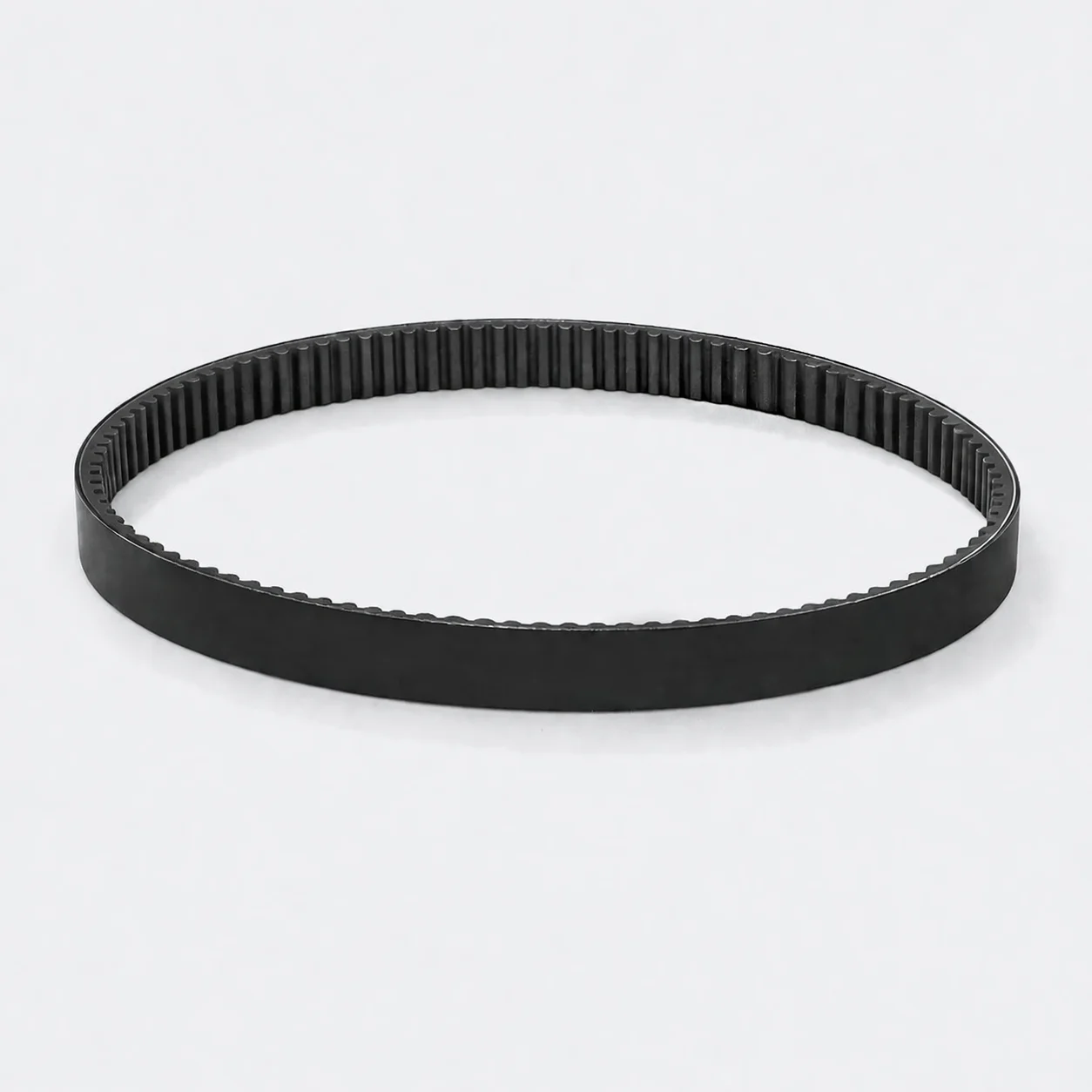

ConCar Variable Speed Belts 22x8 – 1,600 mm inner length – DIN 7719 / ISO 1604
This ConCar Variable Speed Belts with a 22x8 profile and an inner length of 1,600 mm, is a toothed variator belt conforming to DIN 7719 and ISO 1604. Variable Speed Belts are the mechanical alternative to frequency converters: they regulate the output speed purely through geometry, without electronics, harmonics, or an additional heat source in the control cabinet. In many woodworking, textile, and agricultural machines, this remains the more robust solution because it operates reliably even in dusty, humid, and vibration-prone environments.
With an inner length of 1,600 mm, this belt is one of the longer versions of the 22x8 profile. For two equally sized pulleys with a 400 mm effective diameter, this corresponds to a center distance of approximately 190 mm. Long belts are less prone to bending stress; at 20 m/s, they rotate only about 12.2 times per second. However, they require more attention to tension: the slack side tends to flutter at large center distances, and the belt's own mass generates additional centrifugal force during operation, which reduces the contact pressure on the pulley.
For design and comparison with an existing belt, the three length specifications are important because manufacturers use different reference dimensions. The inner length (Li) is 1,600 mm; it is measured at the inner circumference of the belt and is the standard ordering dimension in Germany. The effective length (Ld) of 1,640 mm refers to the neutral axis and is the dimension used in many catalogs and drive calculations. The outer length (La) of 1,650 mm is measured at the back of the belt. With a profile height of 8 mm, the difference between the inner and outer lengths is 50 mm, which corresponds to twice the difference in circumference across the belt height. When replacing an old belt, always compare using the same reference dimension; otherwise, you can easily be off by several centimeters.
Internal length (Li): 1,600 mm
Effective length (Ld): 1,640 mm
External length (La): 1,650 mm
Profile: 22x8 according to DIN 7719 / ISO 1604
Top width: 22 mm
Height: 8 mm
Flank angle: 25°
Construction: open-sided, toothed
Mixture: Chloroprene (CR)
Tensioning material: Polyester cord
Antistatic: yes, according to ISO 9563
Temperature range: -30 °C to +80 °C
Belt speed: up to 30 m/s
Weight: 0.256 kg
Article number: G422081600
EAN: 4059213020790
Manufacturer: ConCar
In terms of materials, ConCar combines a chloroprene body with a polyester tensile member. This pairing is the industry standard for variator belts because it simultaneously fulfills two opposing requirements: The belt must be flexible enough to bend over a small diameter, yet stiff enough longitudinally to resist flexing under load. Antistatic treatment according to ISO 9563 is standard on ConCar belts and is not an additional cost option.
The 25° flank angle is the crucial difference compared to a conventional V-belt, which operates at 34 to 40 degrees. The shallower angle generates less wedging effect per millimeter of radial travel, ensuring smooth belt operation across the entire pulley adjustment range and preventing binding at the end positions. Simultaneously, the large upper width of 22 mm provides the necessary contact area to transmit torque solely through friction. The toothed underside reduces bending stiffness to such an extent that the belt can operate even on small effective diameters without the flanks overheating due to internal flexing.
Belts of this size are typically found in compact drives: bench drills and small lathes with continuously variable spindle speed, feed drives on band and circular saws, laboratory centrifuges and shakers, dosing and small conveyors in packaging lines, as well as garden equipment and small drives where the installation space does not allow for large pulleys.
What these applications have in common is that the rotational speed must be adjusted during operation to suit the material, batch, or demand. A Variable Speed Belts solves this problem purely mechanically, without any electronics in the drive train. This is advantageous wherever dust, moisture, vibration, or temperature would damage a frequency converter, and it remains the only economical solution for existing machines because the variator is an integral part of the machine's design.
For installation: Open the pulleys, place the belt on without tension, then adjust it to the required tension using the adjustment mechanism or the motor rocker. The belt must never be pulled over the pulley edge or pried open with a tool. After approximately 24 hours of operation, the belt will have settled; at this point, the tension should be checked a second time and adjusted if necessary. Insufficient tension leads to slippage and burns the belt edges, while excessive tension puts unnecessary stress on the bearings and tension members.
Before you classify a belt as worn, it's worth taking a look at the pulley. A worn groove allows the belt to sink deeper, causing it to sit on the bottom of the groove and lose contact with the belt flanks. This manifests as a sudden loss of power, even with a seemingly new belt. This can be checked in a minute using a groove feeler gauge.
Variable Speed Belts are standardized according to DIN 7719 and ISO 1604. A belt with a 22x8 profile and a 1600 mm inner length is therefore dimensionally identical regardless of the manufacturer; no modification of the pulleys is required for replacement. This ConCar belt replaces, among others:
OPTIBELT: VB 22x8 / VARIO POWER 22x8
GATES: Multi-Speed 22x8 / Predator V Variable Speed
CONTITECH: VARIO Speed 22x8 / CONTI-V VARISPEED
MEGADYNE: VARISECT 22x8
MITSUBOSHI: VARI-SPEED 22x8
BANDO: Variable Speed 22x8
PIX: Variable Speed 22x8
The belt is supplied as a single, endless belt. Standard lengths and common profiles are available from stock; custom lengths and widths are available upon request. If you are unsure which length your drive requires, please send us the part number of your old belt or the dimensions of your pulleys, and we will check the compatibility.